Prologue: The Oath of Frost and Bone
The Icebloods are two brothers, Warrax and Grymax, who have walked six worlds over nearly thirty years under one cold bargain. They do not die where they fall. They wake in the next realm, colder than before, and go back to work.
Blood freezes. Bone remembers. The harvest never ends.
Oath of the Iceblood
| Brother | Called | Other names across the realms | Nature |
|---|---|---|---|
| Warrax Iceblood | The Soul Eater | Skunk, Skunk Souleater, Beergoth | The planner. Binds beasts, reads the land, counts the dead. |
| Grymax Iceblood | The Big Dogg | Phoonzang | The hammer. Walks in first, leaves last, never asks twice. |
Wherever the brothers go, the name goes with them. In Britannia it was spoken in the bars of Buccaneer's Den. In Azeroth it is carved over a garrison in the Alterac Mountains. This chronicle records how both came to be.
Chapter One: The Blood of Mondain
The Icebloods were born in chains, sons of the wizard Mondain and a dark elf he dragged up from the bottom of the world. Their mother raised them for one purpose: to kill their father. This is how they did it.
I. The Wizard Who Hated the King
In the elder days, before Britannia had a name, the world was called Sosaria. It was four great lands under one sky: the Lands of Lord British, the Lands of the Feudal Lords, the Lands of Danger and Despair, and the Lands of the Dark Unknown. Over all four fell the shadow of Mondain.
Sosaria was a world born of ancient sorcery, yet its people feared magic. They believed its use corrupted the souls of the careless, and most left it alone. Mondain did not. He woke the slumbering powers of alchemy that others shunned, bent the Gem of Immortality to his will, and bound all of Sosaria in his grip.
Mondain was the greatest wizard Sosaria had ever known, and the most vile. In his youth he murdered his own father to steal the secret of the Gem of Immortality. With that gem he meant to become a god, and he very nearly did.
Only one throne stood in his way, and Lord British sat upon it. The king ruled by law and by the love of his people. Mondain could not steal love, could not bind law with any spell, and so he hated both with a patience that outlasted kingdoms.
Worse than the king was the Stranger. Lord British had summoned a wanderer from another world, a traveler from the stars, to stand against the darkness, a mortal with no claim to Sosaria and no fear of Mondain. The ages would one day call that wanderer the Avatar. Mondain called the Stranger loathsome, and meant it with every breath.
Each time Mondain's armies marched, the king's knights and the Stranger's blade turned them back. Each defeat was a coal added to the fire. In the end Mondain came to a terrible conclusion: nothing on the surface of Sosaria would ever be enough to destroy them. He would have to look beneath it.
II. Beneath the Deepest Dark
Mondain went down. He walked the dungeons every adventurer in Sosaria feared to name: the Unholy Hole, the Lost Caverns, and the pit men called Mondain's Gate to Hell, which bore his name because nothing that entered it ever came back. He stripped their treasure rooms, bound their demons, and broke their guardians. None of it was enough.
So he went deeper. Below the lowest level of any dungeon on any map, past the roots of the mountains, his witchlight lit tunnels no living Sosarian had ever walked. The air grew still and old. The silence grew heavy enough to hear.
For seasons he followed those tunnels down, hunting the relics of the denizens of the deep dark. He found crowns of drowned kings in black lakes, lanterns that burned without flame, and idols that whispered the names of things that had died before the sun was lit. Each relic made him stronger. Each one told him the deep had masters he had not yet met.
Then the walls began to show carvings, and the carvings were not human. They showed a slender, pale-haired people with eyes like coals, riding great spiders into battle and offering the hearts of their enemies to the dark.
At a depth where even Mondain's magic guttered like a candle, he found their city. Black spires rose from a cavern wider than any surface valley, lit by violet fungus and veins of glowing stone. It was older than Lord British's line, older than the first Sosarian kings, and forgotten by every scholar who had ever lived.
Its people were the dark elves, a race the surface had lost all memory of. They were swift and cruel and beautiful, steeped in a shadow-magic Mondain had never seen in any spellbook. For the first time in his long life, the wizard watched another power and felt something close to awe.
III. The Captive
Mondain did not come to the dark elves as a conqueror. He came as a thief. Wrapped in silence spells, he watched their war-bands from the edges of the tunnels, learning how they fought, how they cast, and what they worshipped.
What he saw stirred something in him that was almost envy. Here was a people born to the dark. They did not have to murder their fathers or claw through dungeons to take its power. It ran in their blood.
His chance came after a raid gone wrong in the outer tunnels. A dark elf war-band had fought something vast and nameless in the black waters, and in the retreat one warrior was left behind. She was a battle-priestess, bleeding from a wound that would have killed any human, still burning with shadow-fire as she crawled toward the city.
Mondain stepped out of the dark to take her. Wounded and alone, she still killed two of his summoned guardians before his binding spell closed around her. He watched her fight with the cold attention of a jeweler studying a stone, and in that moment he decided what she was for.
The dark elves would speak her name in mourning for generations, but Mondain never spoke it once. To him she was only the captive. He chained her in silver, sealed her wounds with fell magic so she would live, and carried her up out of the deep dark, past every dungeon and every guardian, to his black keep in the Lands of Danger and Despair.
IV. The Breeding of Heirs
In his keep Mondain studied the captive as he studied every artifact he had stolen from the deep. Her people saw without light, moved without sound, and drew strength from shadow itself. His own blood carried the greatest magical mind Sosaria had ever produced.
Joined together, he reasoned, they would make something neither could be alone. He did not want sons. He wanted weapons: heirs born with his intellect and sorcery, and the dark gifts of her people in their bones. An army of his own blood to march on Lord British's castle and drag the Stranger down into the dirt.
The captive fought him at every step. She was a battle-priestess of a proud people, and she was broken slowly, over years, with every cruelty a patient mind could invent. What was done to her in that keep, the Icebloods have never spoken of aloud.
Not everyone in the keep welcomed Mondain's scheme. Minax, his apprentice and lover, watched the dark elf with cold and growing jealousy. She swore that no child of a cave-witch would ever stand above her at Mondain's side, and she would keep that oath long after Mondain was gone. It was the first enmity the Icebloods earned before they could even walk.
V. The Name of Ice
The first child was born in the deepest winter the Lands of Danger and Despair had ever known. Snow buried the keep to its battlements, and the cell where the captive labored was so cold the stone wept frost. Mondain named the boy Warrax, a war-name, a weapon's name, and left without touching him.
His mother held him alone in the dark. She looked into his eyes, one half her own and one half his father's, and felt years of hatred break open into something she had not felt since the deep. She knew exactly what Mondain meant her son to become. In that moment she chose a war of her own.
She would raise him to be the thing that destroyed his father.
She gave him a second name, spoken only in whispers in the tongue of her people: Iceblood. It was not a blessing. It was a warning and a command. To survive Mondain, her children would have to keep their blood cold, their hearts hidden, and their patience longer than his cruelty. When the day came, they would have to be ready, and they would only get one chance.
Let your blood run cold, my sons. Cold blood does not boil over. Cold blood waits.
The first teaching of the mother of the Icebloods
VI. Brothers in Chains
Over the long years more sons followed, and Warrax gained many brothers. Each was gifted. Each was broken a little more by their father's hand. But of all of them, the one who stood closest to Warrax was Grymax.
They were opposites bound together. Warrax had his father's mind: he read spellbooks before he could lift a sword, and the beasts in the keep's pens followed his voice and no one else's. Grymax had his mother's fury: huge for a half-elf, fearless to the point of madness, and so strong he bent the iron frame of a training dummy at nine years old.
The training of the day. Mondain trained his sons without mercy. He drilled them in battle-magic and swordwork until their hands bled. He made them fight one another until one could not stand, then sent the loser into the dungeons beneath the keep to kill or be killed. Brothers who failed did not come back, and Mondain never spoke their names again.
The training of the night. When the keep slept, their mother trained them in secret. She taught them the shadow-ways of the dark elves: how to move unseen, how to speak with hands instead of words, how to see in a room with no light. She taught them to read their father's moods the way a hunter reads weather, and to watch for the weakness that would surely come. Above all, she taught them to wait.
Warrax learned to plan. Grymax learned to strike. From the dungeons and the duels and the long nights in their mother's cell, the two of them learned the one lesson that would carry them through every world to come: in a house of monsters, the only person you can trust is the brother beside you.
VII. The Fall of Mondain
The moment came after Mondain's last and greatest campaign against Lord British and the Stranger. He had thrown every army, every demon, and every relic of the deep into it, and he had lost. He came home to his keep torn and bleeding, his forces broken behind him, his magic burned to embers, the Gem of Immortality clutched in a shaking hand.
The bards of Lord British's court still sing that the Stranger alone struck Mondain down and shattered the Gem. The bards were not there. The Stranger's blade had wounded him. His sons finished it.
Their mother gave the signal with a single word in the old tongue. The brothers came for their father in the great hall all at once, hidden in the shadow-veil she had spent years teaching them to weave. Mondain sensed them at the last instant. Even wounded, he burned two of his sons to ash before they could reach him.
Then Grymax was upon him. He caught his father's arms from behind and held them with the strength of a dark elf war-band, roaring as Mondain's magic blistered his skin. And Warrax, cold and silent, walked up to the father who had named him and drove a blade of black dark elf steel into his heart.
Mondain looked into his eldest son's eyes and saw nothing there but ice. It was the last thing he ever saw.
As he died, the Gem of Immortality slipped from his hand and shattered on the stone. The world shattered with it. Sosaria broke into a thousand shards, and within each shard lived a perfect likeness of the world, each with its own people, history and destiny. Breaking the Gem did not free the world from its magic; it only scattered it. The souls of every Iceblood in that hall were caught in the breaking. Their blood froze in their veins and never fully thawed.
It was the birth of their curse: an Iceblood who dies does not fully pass, but slips sideways into another world. Ages later, that curse would become the gift a dark god came looking for.
VIII. The Mother's Last Winter
The Icebloods walked out of their father's keep free for the first time in their lives. They carried their mother between them, wrapped in Mondain's own black cloak. Behind them the towers burned, and somewhere in the smoke Minax was already fleeing. In her hands she carried a shard of the broken Gem, snatched from the floor of the great hall, and within her she carried Mondain's last child. She swore vengeance on the sons of the cave-witch.
Freedom came too late for their mother. The years of Mondain's torment had hollowed her out, and once her sons were safe, whatever had held her together let go. She lived only long enough to see the sky above the Lands of Danger and Despair turn from smoke to a clear winter blue.
Her last words were for Warrax and Grymax together. She told them they had done what she never could. She told them their name was no longer a warning but a promise. And she made them swear never to let anyone put them in chains again.
The brothers buried her in the ice beneath a cairn of black stone, the way her people buried their honored dead, so the cold would keep her soul from wandering. Grymax wept without shame and swore to her grave that he would kill anything that ever tried to cage them. Warrax did not weep at all, and that frightened his brother more than anything he had seen in their father's keep.
Then they turned away from the grave and walked together into a broken world, the last free sons of Mondain. Icebloods to the bone.
Here ends the first chapter.
Interlude: The Mistress of Time
Minax survived the fall of Mondain, and she took two things from his keep that would hunt the Icebloods through every world to come: his last child, and the last shard of his Gem.
Shadowguard. Minax fled to Shadowguard, a fortress that stands outside of time. There she bent the sorcery Mondain had taught her into something new. She learned to tear doors through time itself, gates that open onto any age and any world. In the old tales of Sosaria she used them to twist the history of the Stranger's own Earth. In this chronicle she found a better use. Wherever an Iceblood's soul slips after a death, a time door can follow.
Every broken realm. From that day, whenever a world broke around the brothers, Minax had a hand in the breaking. A sundered Britannia, a dead High King in Aerynth, a world gone dark overnight: the Icebloods would come to find her shadow behind each one.
Exodus, the Rightful Heir. In the dark of Shadowguard, Minax bore Mondain's last child and named him Exodus. She raised him on one story: that he was the true son of Mondain, born of love, and that the half-blood Icebloods were thieves born of chains who had murdered his father. Exodus grew into something neither wholly man nor wholly machine, a thing of cold hatred made for one purpose: to erase the Icebloods from every shard. It is a war between brothers of one father, and it has never ended.
The Last Shard. As the Gem broke and the world split, one shard skittered across the stone of the great hall and came to rest at Minax's feet. She took it before anyone saw. That shard holds a sliver of every Iceblood soul caught in the breaking. Whoever learns to wield it can end the curse, and with it end an Iceblood for good: no death, no next world, nothing at all. Minax has spent every age since learning how.
Find the shard before she learns to use it, or none of us wake again.
Warrax Iceblood
Chapter Two: The Dread Lords of Britannia (Ultima Online, 1997)
Ages after Mondain fell, the brothers woke in Britannia in the autumn of 1997, the year the moongates opened to the people of every shard. Sosaria was gone, renamed for the king their father hated. Warrax went to sea, Grymax went with him, and Britannia learned to fear a new name: Skunk.
I. The Skunk of the High Seas
The brothers signed aboard the Widow's Wake out of Buccaneer's Den, the only port in Britannia that asked no questions of the men who drank in its taverns. Her captain was Hask Varrow, called Old Brine, a one-eyed pirate who had sunk more merchant ships off Trinsic and Jhelom than any captain alive.
Old Brine gave Warrax his name the day he came aboard. The young half-elf had his mother's skin, black as a moonless night, and her hair, white as fresh snow. The only beard his half-blood would let him grow was a white goatee on his chin, as sharp as a blade. Old Brine took one look at him and roared with laughter. "Black as pitch and striped in white," he said. "We've shipped ourselves a skunk." The crew called him Skunk from that day on, and by the time the Wake had sunk its tenth merchantman, no sailor in Britannia laughed at the name.
Under Old Brine the brothers learned the sea the way their mother had taught them the dark. Skunk learned to read the wind, to board in silence, and to fight on a pitching deck. Grymax learned that a big man with an axe at the rail ends most arguments before they start.
Grymax got his own name on the deck of the Wake. Her navigator was Mad Ezra Thorne, an old star-gazer who swore he had once sailed through a red moongate into the sky itself. He told anyone who would listen of Phoonzang, a Cosmic Lord of the far stars, an artist and maker of worlds who forged the Astral Dominae, the most powerful artifact in the universe, and hid it on the lost planet of Guardia.
The crew laughed at him, until the night a Trinsic warship caught the Wake off Serpent's Hold. Grymax met the boarders alone at the rail. He fought for an hour with axe and fist and fury, and when it was over the deck ran red and not one marine was left standing. Mad Ezra stood in the blood with tears in his eyes and swore by every star he knew that he had just seen Phoonzang himself, a Cosmic Lord of legend walking in mortal flesh. The crew stopped laughing. From that night the sea knew Grymax Iceblood as Phoonzang.
II. The Rogue and the Road
When the Wake was in port, Skunk worked the land. He delved the dungeons as a rogue, picking the locks of Covetous and Despise and stealing from adventurers as freely as from the monsters. And he patrolled the outer roads with Grymax, the long lonely stretches between the cities, looking for prey.
Those roads gave Skunk his first companions beyond his brother. He rode with Vicious Rumor, quick-tongued and quicker with a blade. He hunted with Lobo, who fought like a starving wolf. And he took in Tibult, a quiet killer who would one day die and rise again as Stinky Corpse.
The greatest of these friendships was with Obsidian Scion, called OS. Together on the Catskills shard they chose the red path, until the guards of every Virtue city knew their faces. In Britannia a killer who gathers enough murders and fame earns a title spoken in fear: Dread Lord. Skunk and OS wore it with pride. Through OS came more allies: Kanien, Panzer, Karma, and Aurin, each brought before Skunk and judged worthy.
III. The Call of Dread City
Every Dread Lord in Britannia shared the same problem. The guards cut a red down on sight, and Buccaneer's Den was the only port that would sell to them. The murderers of the realm were scattered, hunted, and alone.
Skunk meant to change that. He put out a call on the Town Crier of UOVault, the great message hall of the realm, announcing the founding of Dread City: a city for murderers, built by their own hands, answering to no Virtue at all. He called on every Dread Lord across the land to come to him and meet.
Skunk chose the ground himself: the swamps southwest of Destard on the Catskills shard, in the shadow of the dungeon where Britannia's dragons nest. No guard would follow a red into that mire, and any hero who came hunting the Dread Lords would have to march past dragons to reach the gate.
They came. Dread Lords rode in from every corner of Britannia, and among them were warriors of the Undead Lords, the UDL. At their head was the guildmaster Terror, a Knight of the Undead Lords since June 1995, when the guild still fought in the streets of Neverwinter. The Undead Lords had been searching for a place to raise their keep, and when Terror heard Skunk's vision, he knew they had found it. The UDL planted their keep in Dread City.
IV. The Warlords of the UDL
In the years of battle that followed, OS and Kanien fought so often beside the Undead Lords that they swore themselves to the guild. While Skunk was away at sea with Old Brine, the two rose to become the warlords of the UDL. They led its armies in the field and trained its warriors for war.
When Skunk returned from the high seas, OS met him at the docks and told him it was time. Skunk joined the Undead Lords in 1998 and passed through the Rite of Death to be knighted Lord Skunk, a full member of the guild. He did not come alone. He brought his own sworn companions into the guild, and those who shared his cold blood took the Iceblood name.
| Joined the UDL as | Known in Britannia as | Bond |
|---|---|---|
| Warrax Iceblood | Skunk, later Skunk Souleater | Firstborn of Mondain |
| Grymax Iceblood | Phoonzang | Blood brother, always at Warrax's side |
| Zelak Iceblood | Vicious Rumor | Sworn Iceblood |
| Punkax Iceblood | Punkin Drublic | Sworn Iceblood |
| Stinky Corpse | Tibult | Companion of the road |
| Lobo | Lobo | Companion of the road |
The House of Iceblood keeps its doors open. Any who prove their blood runs cold may take the name, and many have.
V. Arch Shadow and Gatekeeper
Skunk rose fast. On joining he was raised at once to the Inner Council, the circle of UDL officers, with the title of Arch Shadow, the Deceiver of mortals and of the enemies and prey of the UDL. By the UDL charter, the Arch Shadow oversees intelligence on every other guild and appoints ambassadors to the evil and neutral houses. Where the Warlord led the Nightmare Legion into battle, the Arch Shadow worked in the dark, sowing lies, setting traps, and leading the guild's enemies to their deaths.
It was in the UDL that he earned his last name. For every soul he sent screaming into the dark, he cut another mark into his ledger, and the guild began to call him Skunk Souleater.
In time he took up the office of Gatekeeper, keeper of the gates of the Castle of Bones. The Gatekeeper chose who would be brought into the Undead Lords to fight for the guild and its god. Every new recruit passed through Skunk's judgment first.
VI. Siege Perilous and the Sundering
When the softer shards grew comfortable, the brothers went where the cold was worst. Siege Perilous was the hardest ruleset in Britannia: no recall, no gating, and no mercy for the careless. The Icebloods thrived there, because a world with no mercy is just their father's keep with better loot.
In 2000 the Renaissance split the land in two: Trammel, where no one could murder another, and Felucca, the old bloody world. The Icebloods saw it as the gods of Britannia building a wall to keep the sheep away from the wolves. They stayed in Felucca until the realm grew small, then followed the pull of the shards to a new world.
VII. The March of Minax (2002)
In 2002 the Factions came to Felucca. Four powers rose to war over the old bloody lands, and one of them answered to Minax. The brothers knew her name the moment the town criers spoke it.
Her faction did not chase towers and sigils like the others. It marched on Dread City. For the first time since the keep burned, the Icebloods stood face to face with the woman who had sworn to destroy them, and with the son she had raised. Exodus walked at the head of her army, tall and cold, wearing their father's face.
The Undead Lords held the swamp. Grymax broke the first assault at the gate, and Warrax led the kin through the tunnels of Destard to fall on the faction's rear. When the line collapsed, Minax did not stay to fight. A door of light opened in the air above the swamp, and she and Exodus stepped through it and were gone.
Dread City stood. But the brothers had learned that their father's widow could reach any world they woke in, and that she would keep coming.
VIII. Britannia Today
The brothers have returned to Britannia on the UO Forever shard. Skunk Souleater walks the roads as an archer and bard, while Warrax Iceblood binds beasts and gates his kin across the land with Magery, the same partnership as in 1997.
Chapter Three: The Realm Wars (Dark Age of Camelot, 2001)
The Undead Lords crossed into a land where King Arthur was dead and three realms were tearing his kingdom apart. Albion, Hibernia, and Midgard had been at war since the High King fell. For sons of a frozen grave, the choice was obvious: the cold north of Midgard, first on the Bedevere server and later on Andred.
Sons of Jordheim. Midgard was a realm of Norse gods, trolls, kobolds, and long winters, ruled from the great city of Jordheim. To the Icebloods it felt like the cold of their mother's grave, with a navy. The brothers took up the arms of the north, and the UDL banner flew over their camp from the first night.
Keeps beneath the skull. Every night the Undead Lords rode out through Odin's Gate into the frontier, where the realms fought over keeps and towers. Keep after keep fell to them, and each time the realm banner went up over the walls, the skull of the UDL went up beside it. Their favorite hunting ground was Emain Macha, the bloody field where Hibernia's armies came to die.
Souls for the harvest. To the rest of Midgard, the Realm War was about land and glory. To the Undead Lords it was a harvest. Every Hibernian and Albion soldier who fell beneath a UDL blade was another mark in the ledger, and Skunk Souleater's ledger grew thicker with every siege.
Relics. The true prize of the war was the relics, sacred objects that gave a realm's fighters power. Midgard guarded Thor's Hammer. Albion guarded the Scabbard of Excalibur, and Hibernia the Spear of Lugh. The Icebloods learned that taking what an enemy worships is the deepest wound you can give.
Darkness Falls. Beneath the frontier lay Darkness Falls, a demon-haunted dungeon whose gates opened only to the realm holding the most keeps. Because the UDL held so many, its gates often opened for Midgard. In its lower halls, among the servants of Legion and Agramon, the brothers felt something older than any realm watching, keeping count of the dead.
The departure. The Realm War never ended; it only turned. When the Undead Lords had nothing left to prove on the frontier, the frost in the brothers' blood stirred again. They fell at a keep in Odin's Gate and did not rise in Jordheim. Grymax swore that as he fell he saw a door of light hanging over the keep, and a woman watching from the other side. They rose in a broken world.
Chapter Four: The Age of Strife (Shadowbane, 2003)
Aerynth was the world the Icebloods loved most, because it was already broken when they arrived. The High King Cambruin had been murdered, his blood had soaked the roots of the World Tree, and the All-Father had gone silent. The Undead Lords invaded the realm of Mourning in the summer of 2003 and made the Age of Strife their own.
The Turning. The sages of Aerynth call the day of Cambruin's murder the Turning. The cursed sword Shadowbane vanished, the gods turned away, and every race on the continent began carving empires from the ruins. To brothers whose blood had frozen the night Sosaria shattered, the Turning felt like home.
Riders of Mourning. The Icebloods did not enter Aerynth as men. They came as Centaurs, the proud horse-lords of the plains, swift enough to run down any fleeing foe. The whole of the House rode in together on four hooves.
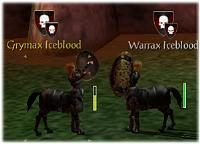
The Crusader and the Prelate. Warrax took the path of the Crusader and Grymax the path of the Prelate. Warrax rode at the head of every charge with blade and banner, and Grymax kept the House standing through every siege, healing the kin faster than the enemy could cut them down.
The brothers gather. In Aerynth the House of Iceblood grew. Zelak and Punkax rode beside Warrax and Grymax, and more Iceblood brothers came after them, each taking the name and the oath. It was the largest the House had ever been.
The Hidden Harvest (2003)
The Undead Lords did not ride onto Mourning beneath their banner. They came in silence, the way their mother had taught the Icebloods to move through Mondain's keep. No one on the continent was to know the UDL had arrived, or how many of them there were.
Wolves among the flocks. The Knights scattered. Each one swore to some other nation's banner, joining guilds all across Mourning under borrowed colors. They fought those guilds' wars, learned their secrets, gained their levels, and quietly gathered gold and power. Their hosts thought they had won loyal new soldiers. They were feeding the dead.
Never a horde. The Undead Lords have never been a mega zerg. They are a tight war machine of Knights who have fought side by side for years, across many worlds. No one becomes one of the kin by simply asking. A recruit must first squire under a full Knight, fighting at that Knight's side until they have proven themselves. Only then is full membership offered, through the Rite of Death.
The shadow of Lex Talonis. While the UDL grew in disguise, Mourning bowed to a superpower. Lex Talonis was the great nation of the realm, a zerg so vast that no guild dared to challenge it. Its banners flew over much of the continent, and its leaders believed they would rule the Age of Strife forever.
The unveiling. In June 2003 Lex Talonis fell in the first mega siege Mourning had ever seen. The battle came to the City of Cornerstone, the seat of the great zerg. As the walls came down and the dominant nation broke, the hidden Knights threw off their borrowed colors, and Mourning learned in a single night that the Undead Lords had been among them all along.
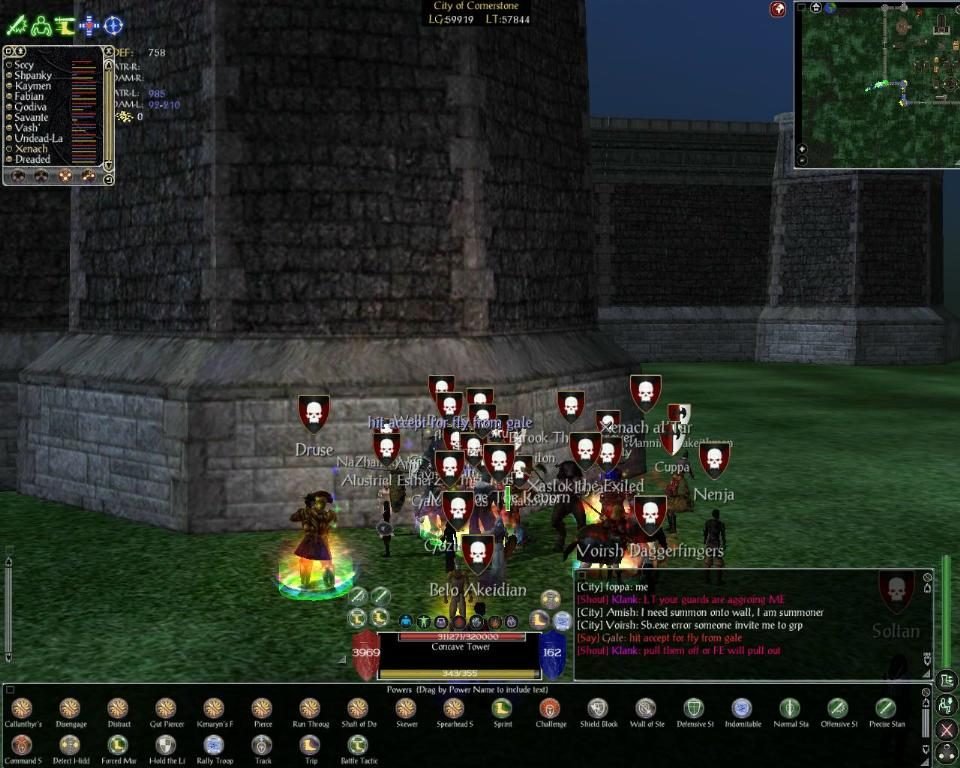
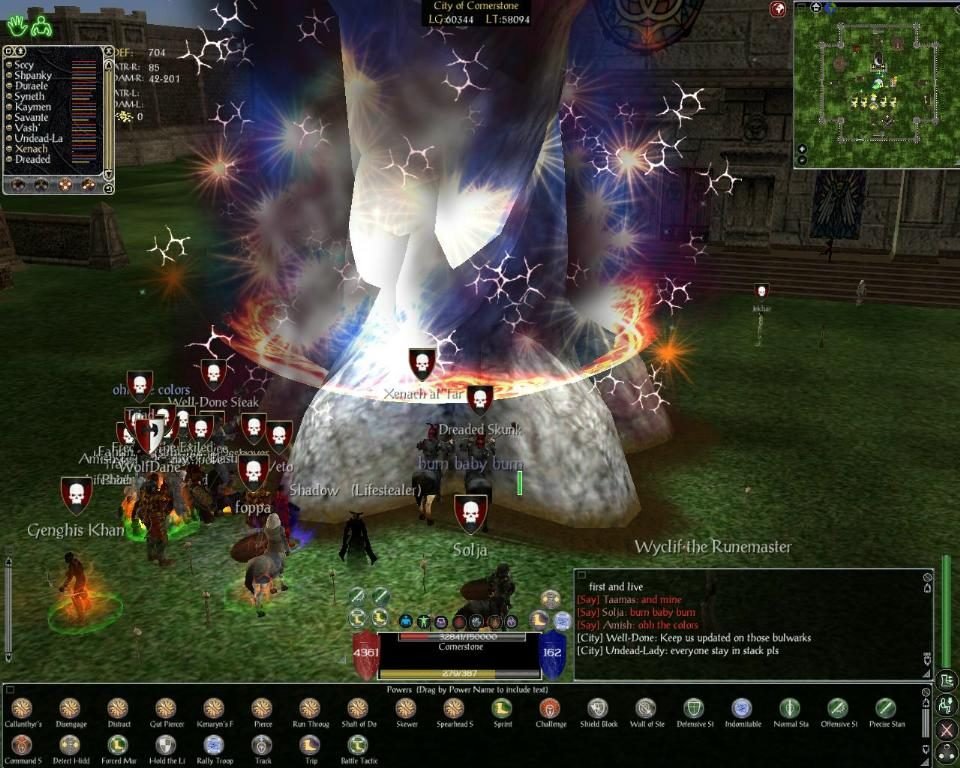
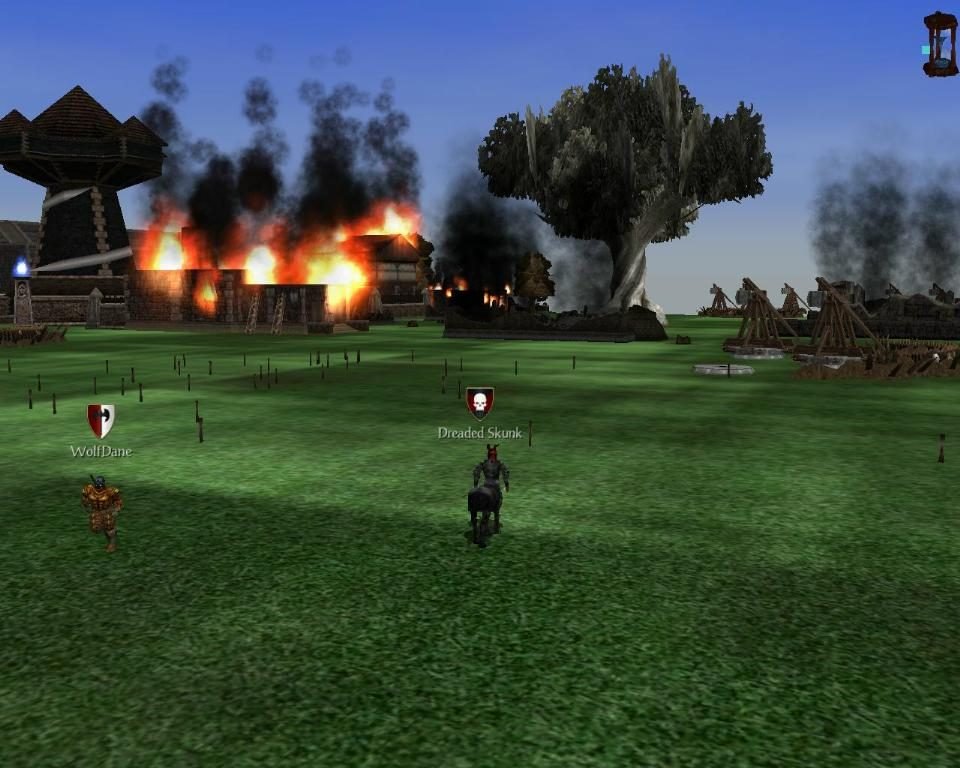
The planting of Dread City. With the great zerg broken, the road to domination lay open. On the Undead Isle the Icebloods and their kin planted their first Tree of Life, and named their first city in honor of the home Skunk had raised in the swamps of Britannia: Dread City. From that night forward, the Undead Lords did not hide.
Lords of Mourning. Under the UDL banner, the Icebloods dominated the realm of Mourning. Dread City's Tree of Life stood when rivals fell, and when enemies planted a bane at their walls, the siege night always ended the same way: Grymax holding the line, Warrax leading the charge, and the attackers' souls tallied in Warrax's ledger.
The Burning of Mordkessel (June 2004)
By the summer of 2004, Warrax Iceblood sat upon the Throne of Skulls as Arch Lich, guildmaster of the Undead Lords. Under his rule the UDL and its Unholy Alliance held Mourning in a grip no other nation could break. Every great city on the continent stood because the Undead Lords allowed it to.
The ally with the prize. Among the nations of the Unholy Alliance was Morloch's Vengeance, a hall of Minotaurs whose city of Mordkessel was the oldest on Mourning, the first Tree of Life ever planted on its soil. No army had ever taken it. Near their keep there walked a frost giant of terrible size, a mountain of ice and fury that no war-band could fell in open ground. The Minotaurs learned to bait it, drag it to their walls, and let their guards and archers bring it down.
When the giant fell, it dropped something found nowhere else in Aerynth: contracts for undead archers, deathless bowmen who could be bound to guard a city's walls. Archers who would never tire, never sleep, and never die. Soldiers made for the Undead Lords.
The offer. Warrax made it plain on the public forums before all of Mourning. Every undead archer contract Morloch's Vengeance ever won would go to the Undead Lords, now and forever, and Lord Casi would pay a fair price for each one. It was a generous bargain, the kind an Arch Lich offers once.
The guildmaster of Morloch's Vengeance refused. He would not have the Undead Lords as his only buyer. Warrax answered him in words all Mourning could read. It was his choice: send the contracts to the UDL for fair payment, or watch his city burn.
The Minotaurs laughed. Mordkessel had never fallen to a siege. They believed the Arch Lich was bluffing. He was not.
The war machine wakes. Warrax was glad of the refusal. The kin, as the full Knights of the UDL call one another, had grown fat on the land after a year without a worthy foe. They needed the thrill of battle. The Arch Lich rallied the full war machine of the Undead Lords, and Lord Zeb sailed to the Minotaurs' island to plant the bane at the walls of Mordkessel.
The siege. On the appointed night the Undead Lords came for the city that had never fallen. The battle was long and savage: Minotaurs holding the walls with axe and horn, archers on every tower, and the Nightmare Legion pouring through every breach. Grymax held the line where it broke. Warrax led the charge where it opened. The harvest that night was the greatest the Undead Lords had reaped on Mourning.
When dawn came, Mordkessel was ash and its Tree of Life was dead. Morloch's Vengeance was wiped out, and it never again rose as a power on Mourning. The undead archers went where the Arch Lich had always said they would go: to the walls of Dread City.
It was his choice. He chose fire.
Warrax Iceblood, Arch Lich of the Undead Lords
Later a UDL faction carried the banner to the Vindication realm as well.
The search for Shadowbane. Like every power on the continent, the Icebloods hunted the lost sword. They never found it. Warrax came to believe someone had hidden it on purpose, because a world without a king is a world that never stops filling graves.
The fall of Aerynth. When the servers of Aerynth went dark on May 1, 2009, the world simply stopped. The Tree of Life went cold and the Undead Lords of Mourning scattered into the shards. The brothers say it was the only death that ever truly hurt. Warrax has never believed it was an accident. The last thing he saw over Dread City was a time door opening, and Minax smiling in it.
Chapter Five: Azeroth (World of Warcraft, 2004 to now)
The brothers woke in the snows of the Alterac Mountains, and the Frostwolf clan found them half-frozen and still breathing. They fought for the Horde from that day forward. Azeroth is the world where the Iceblood name stopped being a whisper and became a place on the map.
The Undead Lords of Azeroth. The UDL raised its sanctioned faction in Azeroth in November 2004 on the Archimonde and Ravenholdt realms, and held it there until December 2007. New Knights were made in this age, among them Lord Chroma and Lord Zers in 2005. Years later Lord Skunk still rode in Azeroth on the Eredar realm, beside Hillbilly, Rayven, Casi, Forsythe, Karma, and Sachant.
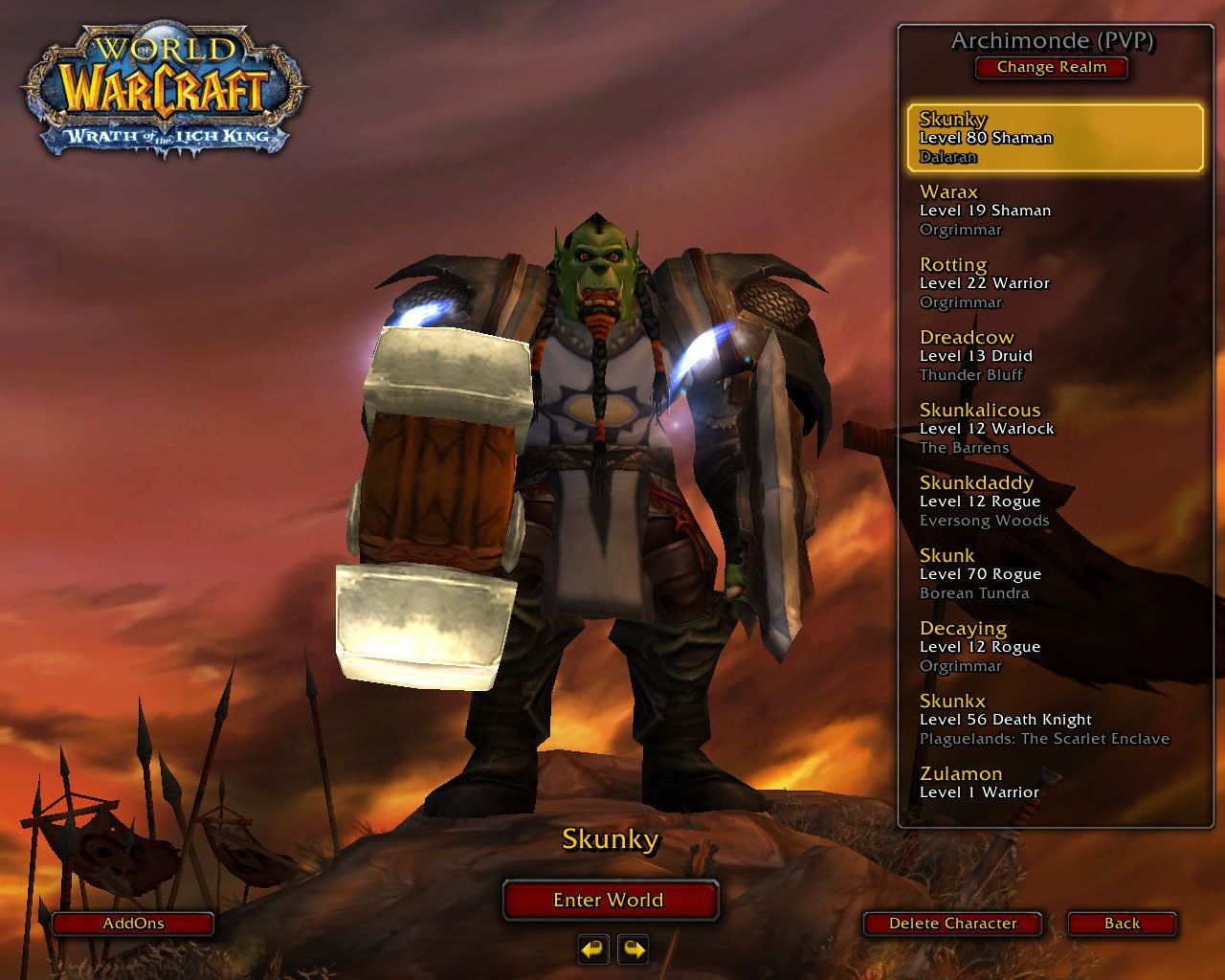
Skunky of Archimonde. By the coming of the Lich King in November 2008, Lord Skunk rode for the Horde on the Archimonde PvP realm as Skunky, a level 80 Orc Shaman of the storm, his Stormstrikes breaking records against the Lurker Below in Serpentshrine Cavern. His other faces on that realm: Warax, Rotting, Dreadcow, Skunkalicous, Skunkdaddy, Skunk the rogue of Borean Tundra, Decaying, Skunkx the Death Knight, and Zulamon.
Iceblood Garrison. In Alterac Valley the Frostwolf orcs and the Stormpike dwarves have fought over the same frozen pass for years. At its heart stands Iceblood Garrison and Iceblood Tower, held by Captain Galvangar for the Horde. Frostwolf elders say the garrison was named for two pale warriors who held that ground through a winter no one else survived. The brothers never deny it.
Beergoth of the Frostwolves. In this age Warrax walked as Beergoth, an orc shaman of the Enhancement and Restoration paths, who answered the call of the elements as he once answered the spirits of Midgard. Grymax fought under the name Phoonzang. Together they rode with Drek'Thar's people, guarded the relief huts, and buried Stormpike dead in the snow the old Frostwolf way.
The rival harvest. Azeroth taught the brothers they were not the only soul-takers in the multiverse. Ner'zhul became the Lich King on the Frozen Throne of Icecrown, and his Scourge stole the dead before they could pass. Kel'Thuzad's floating necropolis of Naxxramas hovered over the Plaguelands like a hoard of stolen coin. To the Undead Lords, the Scourge was a thief, and the brothers made it their work to take those souls back.
Beyond the veil. Later the brothers learned of the Shadowlands, where the Arbiter judges every soul and the Maw swallows the damned. Warrax came to see the Arbiter as just another gatekeeper. The Icebloods learned to claim a soul in the moment between death and judgment, before Azeroth's own afterlife could take it.
Outland and beyond. When the Dark Portal opened again, the brothers crossed into Outland and the shattered world of Draenor. In the burning wastes of Hellfire Peninsula, Grymax said it was the first world that had broken worse than Aerynth. Warrax said that just meant more work.
Interlude: The Bargain in Deceit
The Icebloods made a bargain, not a vow of worship. Their curse gave them something rare, and in 1998 they sold its use to the Undead Lords on their own terms.
Who Myrkul is. In the lore of Faerûn, Myrkul was a mortal necromancer who, with Bane and Bhaal, seized the portfolio of death from Jergal. The three became the Dead Three. His sign is a white skull on a black field, and his old realm was the Bone Castle in the gray wastes of Hades.
The dead god. During the Time of Troubles in 1358 DR, Myrkul was destroyed in the skies over Waterdeep by the mage Midnight, and death passed to Cyric and later to Kelemvor. In the Undead Lords' lore, what was left of him still schemes from the Crown of Horns, and the guild's liches deal in souls to raise him.
Why the liches wanted them. Kelemvor guards every soul of Faerûn, so the liches looked beyond it, to the shards of broken Sosaria. They needed reapers whose souls could cross between worlds and come back. They needed men whose blood had already frozen once.
The sealing. The liches met the brothers in the depths of Deceit, the undead crypts of Britannia. The room went cold enough to frost a bone. Warrax and Grymax cut their palms and let the blood freeze on the stone in the shape of a skull. It was a contract sealed in blood, not a prayer. From that night they rode as the Icebloods, reapers of the Undead Lords.
The terms of the bargain.
- Every soul the brothers claim is counted in the Undead Lords' harvest.
- When an Iceblood falls, the bargain carries him to the next world instead of letting him rest.
- The brothers will never serve Kelemvor, Cyric, the Lich King, or the Arbiter.
- The bargain ends when the last shard goes dark.
The title Souleater. Warrax earned the name Souleater for the count he keeps. He is said to carry a bone ledger with every name he has reaped since Catskills. Grymax keeps no ledger. He says somebody else can count.
Chapter Six: The Return (WoW Forever)
At the launch of WoW Forever, the Iceblood Brothers ride again under their own names for the first time in Azeroth. The ice in their blood stirs, and the ledger opens to a fresh page.
Skyborne of the Horde. In this age the brothers take a new shape: the Skyborne, the windswept elves of the sky whose world faces an ending, who first touch Azeroth on Zephras Isle. Warrax and Grymax ride for the Horde, as the brothers always have. Their skin is black as a moonless night and their hair is white as snow, the same marks their mother gave them in Mondain's keep. Warrax wears the white goatee that gave Old Brine the name Skunk, while the Skyborne line leaves Grymax's jaw bare. They make landfall when WoW Forever opens on November 4, 2026.
| Player | Name in this age | Also walks as |
|---|---|---|
| Skunk | Warrax Iceblood | Skunk (main) |
| The Big Dogg | Grymax Iceblood | Phoonzang |
The homecoming. The brothers return to the Alterac Mountains, to the garrison that carries their name. A Frostwolf elder at Iceblood Garrison is said to keep two empty seats by the fire, and to pour a cup for each every winter.
The battle cry. When the brothers charge together, the Frostwolves hear it from across the valley:
ICEBLOOD! The harvest is ours!
The hunt for the shard. Minax has followed the brothers through every door, from Sosaria to Aerynth. Somewhere in Azeroth she waits, with Exodus at her side and the last shard of the Gem in her hand. This time the Icebloods are done waiting for her to find them. Before she learns to use the shard, they mean to take it, and end the war their father started.
What comes next. Every age has ended with the brothers stepping into a new world. This one begins with them choosing to come back to an old one, and the chronicle will be written as they play.